

8 min read
A plant putting in its own transformer usually raises the question of backup power at the same time. The two investments are linked but are not sized by the same logic. Mismatching them means either unnecessary cost, or a line you assumed would keep running stopping during an outage.
How the transformer is sized
Add up the plant's connected load, then apply a diversity factor — no plant runs every load at full capacity simultaneously. Add any load planned for later plus a sensible allowance for growth. Oversizing the transformer raises no-load losses; undersizing means a second transformer investment within a few years.
The generator rating is not the same figure
A generator is sized for the critical loads that must be fed during an outage. That list is usually less than half the connected load: part of the lighting, refrigeration, the critical process, safety systems and the server room. Loads that can stop are left out. Without that distinction, you either over-invest or end up feeding the wrong circuits.
Starting current: why a generator that adds up on paper falls short
Motors draw multiples of rated current at start-up. A generator is not an infinite source like the grid; direct-on-line starting of a large motor pulls its voltage down and affects other loads. Sizing therefore considers not just total kW but how the largest motor starts. Using a soft starter or a drive noticeably reduces the generator rating required.
The ATS panel: two delays decide everything
- The delay between the generator starting and load being applied — applying load before speed and voltage settle strains it.
- The delay before switching back once the grid returns — switching back on brief fluctuations makes the system hunt.
- A parallel-operation scenario — lets the return to grid happen without cutting load; essential on interruption-sensitive processes.
Compact kiosk or a separate transformer building?
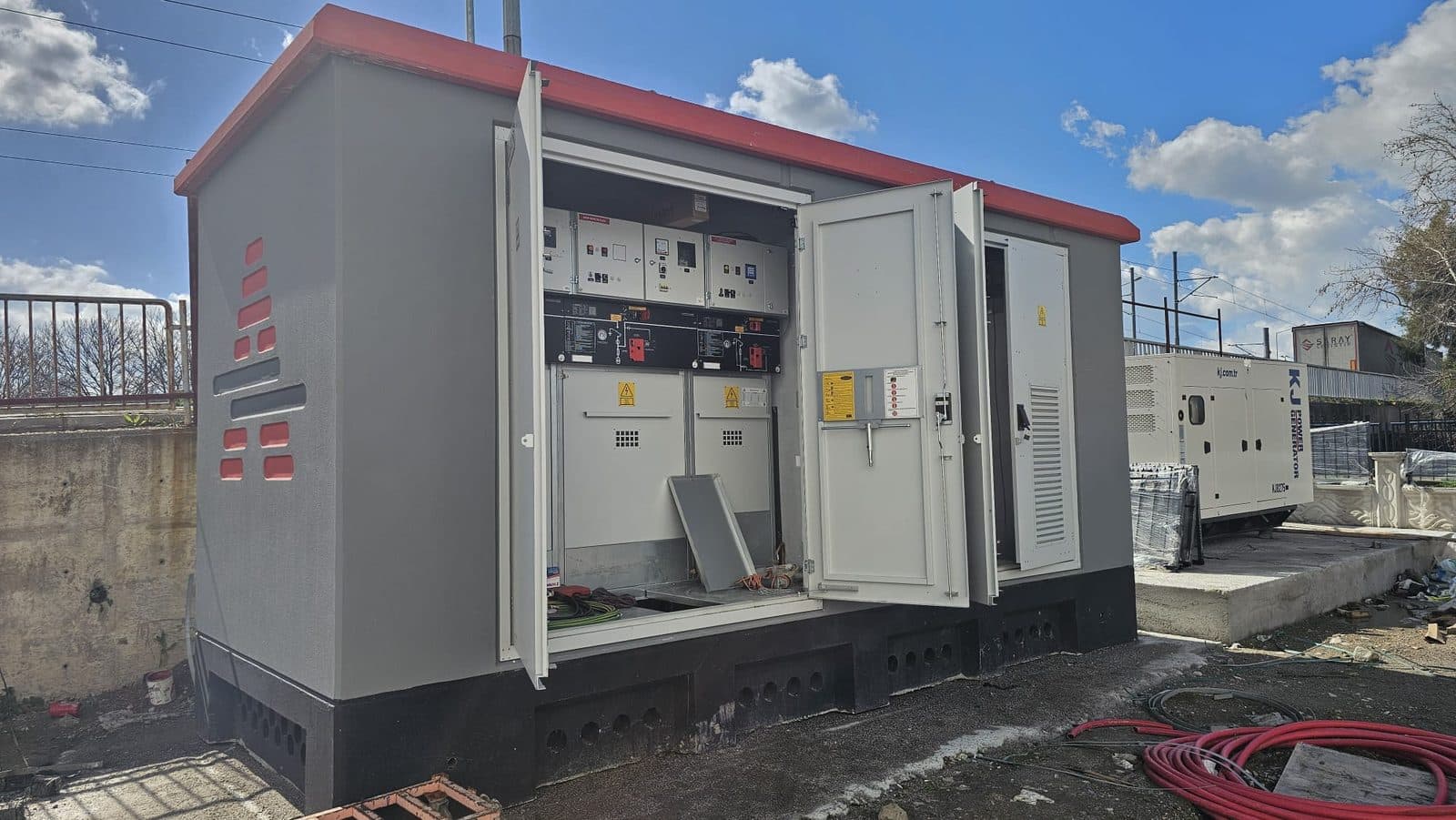
A compact kiosk is built in the factory and arrives ready; the MV cubicles, transformer and LV panel sit in one body. Work on site is limited to foundations and cable connections, and installation is quicker. A separate transformer building is preferred at very high ratings, where equipment will be added later, or where special climate control is needed.
The official process is part of the investment
Installing a transformer is not only buying equipment. Project approval, coordination with the distribution company, technical inspection and energisation set the schedule directly. If the drawings do not match the distribution company's specification exactly, the file comes back and the process restarts. That is why we check drawings against the specification clauses before submission.
Share your connected load list and the loads that must run during an outage; we will scope the transformer, generator, ATS and earthing together. We handle the installation and the official process under one roof.
Frequently asked questions
Does the generator rating have to match the transformer?
No. The transformer covers the plant's total connected load, the generator only the critical load that must be fed during an outage. The difference is the power of the loads that can stop. In practice it is normal for the generator to be noticeably smaller than the transformer.
How often should a generator be tested?
A short monthly run is common practice, but what matters is testing under load. A generator that only idles accumulates fuel-system and exhaust problems over time. At least once a year it should be tested under real load, including the ATS transfer. The results should be recorded.
Why does a two-source installation need a separate earthing design?
The grid and the generator are two separate sources, and how each one's neutral point is connected decides whether the protective devices work correctly in both states. Wrongly connected, residual current protection may fail to operate while the generator is running, or trip continuously. Earth resistance should be measured before commissioning and the result added to the handover file.
Can a UPS replace a generator?
No, they do different jobs. A UPS leaves no gap at the moment of an outage but runs only as long as its batteries allow — usually minutes. The UPS covers the time until the generator comes on line, and the generator carries the long outage. For servers and control systems the two are used together; for production loads a generator alone is usually enough.